No work speaks for itself.
For a while, everyone believes the result is enough.
Maybe you have believed it too.
Over the years you come to notice an invisible line:
on one side, those who know how to translate their own worth, making their own voice their main product; on the other, those — like many of us — who believe the work is enough, with no need for more exposure.
Balancing on that tightrope are the communicators.
People who flirt with both sides, stretch roles and reveal their voices and their labours.
And I believe that, as happens with those who create too much, we often hide behind work we consider complete.
As if the result alone could say everything.
The self-image
Whenever I think about images and messages, the case of Gustave Courbet has always struck me as particularly telling.
Recognised as an exceptional naturalist, he painted bodies at work or in pain without sparing flaws or softening imperfections. When he portrayed himself, Courbet chose to paint himself as one of his most beautiful figures.
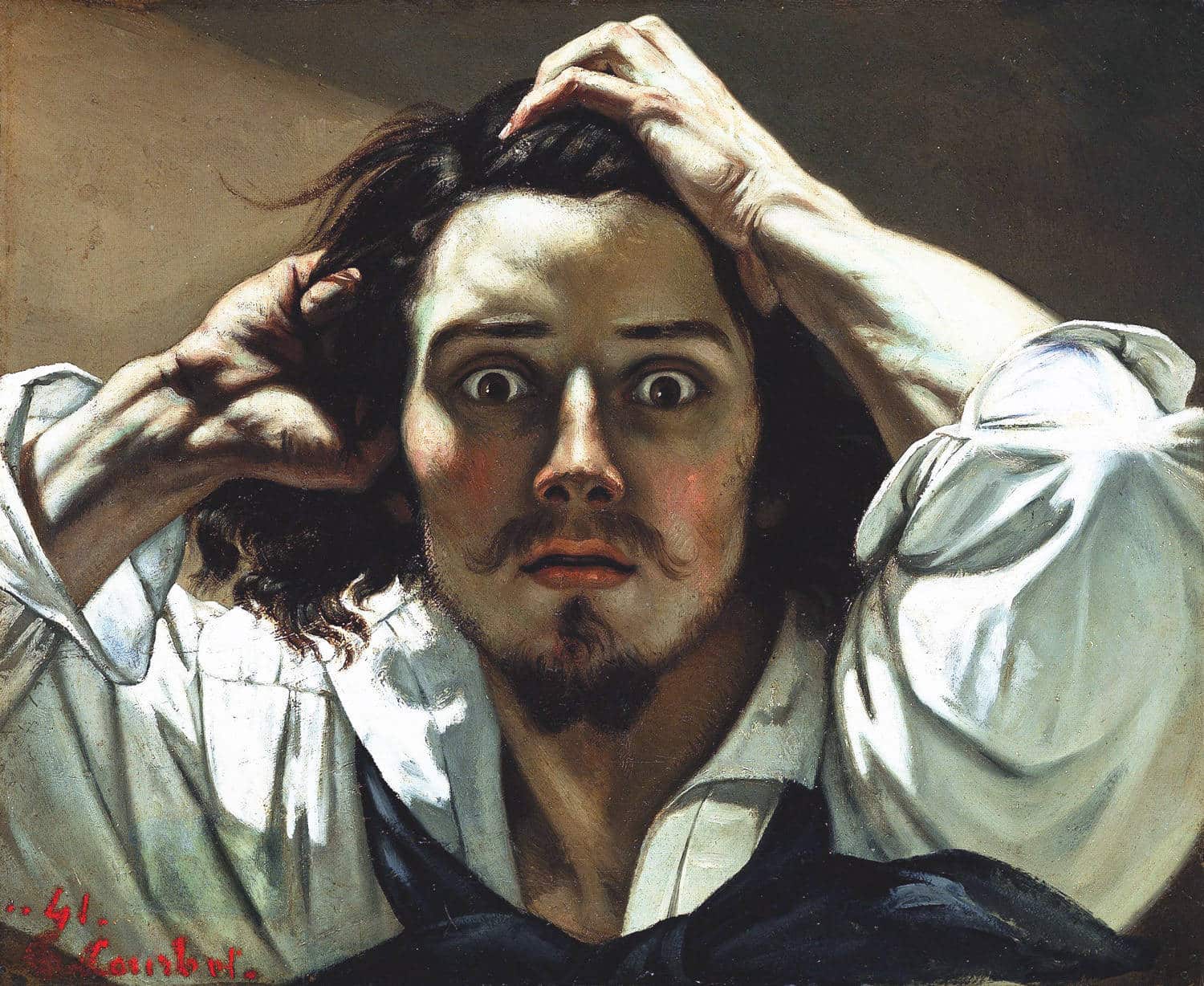
Le désespéré — Gustave Courbet
Self-esteem or dissociation? We'll never know. But how much that “voice” — heard through devoted brushstrokes — conveys his truth, his intention. Courbet, committed to portraying his vision, stamps his own reading of reality onto it.
That episode in art history brings me back to the present with an almost uncomfortable clarity:
we put ourselves out into the world the way we would like to be recognised.
Unlike a painter, we don't represent ourselves the same way — at least not in the same proportions. That absence becomes a relevant flaw once we understand how the market perceives a brand and decides to engage with it.
So what has changed in the way we think about how much our work really represents us? Or about how we believe everyone should see it.
Well, perhaps the first realisation is the most obvious one:
all of us, besides being creators, are also communicators.
The harder realisation is that yes, we can do things without popularity being the goal. But if no one knows something exists, its commercial reach is limited, and we'll never know how far an initiative could go.
No doubt you have skipped a restaurant because it hadn't posted anything in six months — leaving you wondering whether the place is even open.
The second realisation follows right after: to some extent, we are all artists.
By ‘Art’ I mean “ars”, from Latin, in the sense of craft. And technique, as in ‘techné’, from Greek, as the idea of method and know-how. Hard not to picture Mario Sergio Cortella at this point in the etymology.
Whatever the field, the service or the nature of what we do, creating and applying method is a constant.
And so is the responsibility to show what we create and take a position from it.
The line we drew at the start — a body that works, so far from and so different to the voice that spreads its own ideas — is nothing but an illusion.
Coming back to that thought, it falls short of reality for one simple reason:
A voice doesn't exist without a body,
a body goes unnoticed without its voice.
The false notion that we could separate essential parts of ourselves — like the idea of separating the rational from the emotional, the conscious from the unconscious mind — as if they didn't exist in a dependent, ecosystemic relationship with each other.
A natural balance in which, without one, the other collapses on itself.
And facing the balance needed between body and voice, one more thing becomes clear:
the voice doesn't matter if there is no soul.
The body that speaks
The best “body” of work can't stand without the soul and voice of the people behind it.
That soul is the essence we put in entirely — body and soul.
Our soul takes on our greatest desire before we can even understand it,
guiding our words in the most complete way.
It is as much dedication as it is will.
As much intention as motivation.
As much preparation as vocation.
Aligning body, soul and voice is being present.
A supposed neutrality of that voice — perhaps even an attempt at otherness — becomes empty.
The defence of the work disappears when the person who does it is absent.
What is often an intentional “low-profile” stance ends up, in practice, as one more case of “out of sight, out of mind”.
And that is definitely not enough for us.
We are made of our connections and of the dialogues that arise among those voices.
And what moves me, before anything else, are the people involved.
I don't remember every brand I saw last year.
I don't remember the billboards that caught my eye the most.
Or an amazing project I saw in the first half of the year.
But I remember the people I worked with.
And the people I looked to for inspiration.
Sometimes a small photo in a newsletter is all it takes:
the faces of people I know create, speak and share their own work.
Good work, on its own, isn't enough.
We need people.
Because this ecosystem is only complete with all of its parts.
The anthropophagic being
Talking about what we do matters.
As we learn to talk more about what we do, we get the chance to open our way of thinking to the world. It keeps us present to exchange experiences while we go on learning.
We are artists of our own subjects.
And we must take the position of being present.
Otherwise we isolate ourselves in sterile aquariums, closed systems, cut off from the natural exchange that happens with the whole.
No one is self-taught in the absolute sense.
We seek out and learn from other people, and we always find those who have already started this movement of presence.
We are talking about a living ecosystem, a triad like so many others.
Beginning, middle and end, in a cyclical, endless movement.
The word, the intention and the listening that make up a dialogue.
Our provocation here is simple:
be true to yourself and to what you do,
without hiding, or fearing where your voice might reach.
Be real, present and open to the discussions that come up.
That way we can also align our triad — body, soul and voice.
In our own direction.
Today we better understand the power of being present:
in the same rooms, at the same events, in the same moments.
We hope to run into you out there.
With body, soul and voice present.
Cover illustration: Laura Dias.